
The Liver-Gallbladder Node: Temporal Master Regulator of Metabolic Coherence
Integrating organ rhythms, terrain states, and herbal strategies in network physiology

This is Part 9 in an ongoing series exploring herbal medicine in the context of systems science and network physiology. The information in this post is provided for educational purposes. While I discuss herbs and organ system patterns, this should not be taken as medical advice for any specific individual. Please consult a qualified healthcare provider before making changes to your health regimen.
Over the past several posts, I have been developing a model of health rooted in networks of functional organ systems. In this framework, organ systems act as nodes, while their neuroendocrine–immune connections form the edges. This network perspective—grounded in both traditional medicine and modern systems science—shifts the clinical question from how do we treat disease to how do we foster resilience and coherence across systems.
Earlier essays introduced the distinction between primary and secondary organ nodes, showing how primary nodes (e.g., gastrointestinal, kidney, lung, heart) function as central regulators of physiological balance, while secondary nodes (brain, skin, muscle, bone) serve supportive roles. I also outlined how stressors can push these networks into characteristic terrain patterns, shaped by the balance of metabolic, neuroendocrine–immune, circulatory, and formative activities. My working hypothesis is that herbal therapies act on these terrain attractor patterns—not through single mechanisms, but by modulating multiple signaling pathways in parallel, restoring coherence at the node level. In this sense, polyherbal formulations can be understood as intelligent interventions that promote salutogenesis.
Most recently, I explored the GI node, examining its anatomy, functions, terrain states, and corresponding herbal strategies. In this post, I turn to the hepatobiliary (liver–gallbladder) node, but with an added dimension.
Up to now, my discussion has emphasized the spatial aspect of nodes—their structure and interconnections. Yet living systems are not only spatial—they are also temporal. Every organ is a biological oscillator, governed by circadian and ultradian rhythms that synchronize metabolism, signaling, circulation, and tissue formation. Traditional medicine has long emphasized organ-time relationships, and modern chronobiology confirms that when rhythms falter, resilience erodes and illness emerges.
I propose that herbal therapies address terrain attractor states not only through spatial modulation but also by entraining and restoring organ rhythms, thereby reinforcing systemic coherence at its deepest level.
With this temporal lens in place, we can now explore the hepatobiliary node—its rhythms, terrain states, and the polyherbal strategies that re-establish coherence within this master regulator of metabolism.
What Are Organ Clocks?
Every organ in the body contains its own biological clock—a molecular timing system that governs daily cycles of activity.1 These organ clocks form part of the broader circadian system, a hierarchy of oscillators.2 At the top sits the central clock in the suprachiasmatic nucleus (SCN) of the brain, synchronized primarily by light. From there, the SCN entrains peripheral clocks in individual organs via hormonal and neural signals. Yet these local clocks also respond to direct cues such as feeding, fasting, and temperature.
This temporal architecture ensures that each organ performs its functions at the most appropriate time of day, optimizing efficiency and maintaining balance under stress (homeostasis/allostasis). Physiology is thus not only spatially networked across organs but also temporally coordinated through oscillations.
The Gut as an Example
The gut demonstrates this principle vividly:
Epithelial clocks. Intestinal epithelial cells regulate daily expression of genes for nutrient transport, digestion, and barrier integrity—peaking during the day, when food intake is expected.3
Microbial clocks. The trillions of gut microbes (microbiome) also follow 24-hour cycles. Their composition, localization, and metabolite production shift with feeding–fasting rhythms.4
This relationship is bidirectional: host clocks shape microbial rhythms, while microbial metabolites feed back to influence host timing. When disrupted by shift work, chronic jet lag, or irregular eating, this partnership desynchronizes—leading to impaired barrier function, dysbiosis, and downstream effects on immunity and metabolism.
The Spleen Clock: Tradition Meets Chronobiology
In my previous post, I described the spleen as an “immune brain” of the digestive system. It too demonstrates rhythmic activity.
Traditional medicine. In Traditional Chinese Medicine (TCM), the spleen’s Qi peaks between 9 and 11 a.m., the time when food is said to be most effectively transformed into energy and blood. This timing supports both vitality and mental clarity.
Chronobiology. Modern research confirms that the spleen contains its own molecular circadian clock, regulating immune cell trafficking, blood filtration, and hematologic balance.5
When the spleen’s clock falters, immune–metabolic dysfunction follows:6
Misalignment promotes low-grade inflammation, a hallmark of obesity and insulin resistance.
Disruption alters communication with adipose tissue, skewing immune cell balance and impairing metabolic flexibility.
Because clocks are interlinked, disturbances in the SCN cascade into the spleen and other nodes, amplifying systemic desynchrony.
Here, TCM insight and modern biology converge: when the spleen’s rhythm is lost, inflammation and metabolic imbalance emerge.
Beyond Signals: Synchrony and Oscillators
So far, I have described the edges of organ networks as the neuroendocrine–immune signals exchanged between nodes. The concept of organ clocks adds another dimension: each organ is not only a biochemical processor but also an oscillator—a rhythmic entity that must remain in temporal synchrony with the rest of the system.
The natural oscillations of organs generate weak but measurable electromagnetic fields. With the exception of the heart7—whose field can be detected several feet from the body—these rhythms are subtle, but they ripple through the network and may provide an additional layer of coordination. Research here is nascent, but the implication is profound: health depends not only on biochemical signals, but also on the temporal tuning of oscillators across the system.
From this perspective, disease can be understood as desynchronization—organ clocks drifting out of tune, producing discordant rhythms. Medicine, then, is not just about “fixing parts,” but about retuning oscillators so that coherence and harmony are restored. This metaphor of tuning better captures the dynamic nature of living physiology than the mechanistic metaphor of repair.
Looking ahead, it is conceivable that alongside vitals, labs, and imaging, we may one day chart a patient’s organ rhythms, offering a window into how desynchronized clocks contribute to illness—and how they might be reset.
The Hepatobiliary Node Re-examined
The Liver–Gallbladder (LG) Node is one of the body’s most decisive regulators of systemic balance. More than a metabolic hub, it serves as a regulatory nexus, integrating signals across networks and maintaining coherence between the body’s inner milieu and the external environment. Its activities span detoxification, digestion, immune surveillance, reproductive timing, and stress adaptation—making it a master integrator of life processes.
Anatomically, the liver is a vascular lattice of hepatocytes, sinusoidal endothelium, and Kupffer cells optimized for transformation and clearance. Functionally, however, the LG Node expresses itself through a dynamic interplay of four interdependent dimensions—the same categories I have been developing for herbal diagnostics:
Metabolic activity (Yang).
The liver orchestrates both anabolism and catabolism: synthesizing glucose, lipids, and proteins (e.g., gluconeogenesis, lipoprotein and clotting factor production), while simultaneously clearing xenobiotics and conjugating hormones. The gallbladder represents the excretory face of this Yang activity, storing and releasing bile to externalize metabolic byproducts into digestion.Signaling & autonomic activity (Qi).
Richly innervated by sympathetic and parasympathetic fibers, the LG Node adjusts hepatic tone in response to feeding, fasting, and stress. Beyond neural control, hepatokines (FGF21, IGF-1) and Kupffer-cell cytokines act as molecular messengers, relaying hepatic state to brain, muscle, adipose, and immune systems.8 This Qi dimension makes the liver not only a metabolic processor but also a perceptive and directive node in the physiological network.Circulatory activity (Blood).
The liver is the great regulator of blood quality. It detoxifies, modulates clotting, stores iron and vitamins, and even contributes to hematopoiesis in early life. Positioned at the confluence of portal venous inflow and rhythmic bile outflow, the LG Node functions as a circulatory crossroads, linking digestion, immunity, and systemic distribution into a coherent whole.Form–fluid activity (Yin).
Through bile, lymph, and plasma proteins such as albumin, the liver stabilizes the fluid architecture of the body. Yin here encompasses both form-building (structural proteins, membranes, connective tissue) and fluid-balancing (osmotic gradients, detoxification currents). Disturbance of this dimension manifests clinically as edema, fibrosis, or cholestatic/lymphatic stagnation.
Together, these four dimensions—Yang, Qi, Blood, and Yin—define the terrain states of the LG Node. Herbal strategies act not by targeting isolated mechanisms but by retuning imbalances within and between these dimensions, restoring the node’s coherence and resilience.
The LG Node and Cross-System Axes
The hepatobiliary system does not function in isolation; it anchors multiple inter-nodal axes that synchronize metabolism, signaling, and systemic resilience:
Liver–Hypothalamus–Pituitary Axis.
Growth hormone drives hepatic IGF-1 production, linking the LG Node to growth, repair, and tissue turnover. The liver also clears cortisol9 and sex hormones10 (HPA and HPG axes) and converts T4 into active T311 (HPT axis). Neural input reinforces this integration: stimulation of hypothalamic nuclei such as the VMH and LHA directly alters hepatic glycogen synthesis and breakdown.12 In this way, the hypothalamus functions as both sensor and regulator of liver activity, coordinating whole-body metabolic homeostasis.Liver–Muscle Loop.
The Cori cycle links muscular lactate release with hepatic gluconeogenesis—an archetypal metabolic–rhythmic circuit that balances short-term muscular demand with long-term systemic energy supply.Liver–Adipose–Brain Axis.
Hepatokines such as FGF21 influence appetite, insulin sensitivity, and thermogenesis, while hepatic inflammation feeds back into autonomic tone and circadian timing.13 This axis underscores how liver health shapes not only metabolism but also behavioral rhythms such as feeding and activity.Liver–Skin Axis.
Although less direct than brain–liver circuits, the liver–skin connection illustrates systemic crosstalk.14 Impaired hepatic function leads to accumulation of bilirubin, bile salts, and inflammatory mediators, producing jaundice, pruritus, or spider angiomas. Conversely, chronic skin inflammation (e.g., psoriasis) increases risk for NAFLD, highlighting a bidirectional loop sometimes framed as part of the gut–liver–skin axis.
Through these and other axes, the LG Node serves as a hub of systemic coherence—modulating energy supply, metabolic tone, and inflammatory balance across the network.
The Liver Clock: Temporal Mastery of Metabolism
The liver is among the body’s most powerful peripheral oscillators, with its functions—detoxification, bile secretion, glucose regulation—tightly synchronized to the 24-hour circadian cycle.15
Day (active phase). Nutrient processing, glycogen storage, and bile production predominate, aligning hepatic activity with food intake and energy demand.
Night (rest phase). Detoxification, gluconeogenesis, and protein synthesis rise, supporting clearance, renewal, and systemic repair.
When this rhythm is disrupted—through late-night eating, chronic stress, or shift work—the liver is forced to work out of phase. The resulting circadian misalignment promotes fat accumulation, insulin resistance, and fatty liver disease.
Traditional Chinese Medicine adds a parallel layer of insight through its organ clock. Here, the liver’s Qi is said to peak between 1 and 3 a.m., a time of inward repair, detoxification, and Blood renewal. Clinically, people who awaken during this window often manifest disturbances in hepatic rhythm—whether from emotional strain, toxic burden, or disrupted sleep cycles. Strikingly, modern chronobiology affirms this intuition: early morning is indeed when hepatic detoxification pathways and glucose regulation are most active.
Taken together, these perspectives suggest that the LG Node is not only spatially integrative and biochemically complex, but also temporally directive—anchoring systemic metabolism to the rhythm of the day–night cycle. When the liver clock drifts out of tune, the entire physiological symphony risks discord. From both modern and traditional standpoints, therapy can be understood as the work of retuning the liver’s oscillator to restore coherence and resilience.
Terrain Patterns of the Hepatobiliary Node
Like other organ nodes, the LG Node can fall into imbalance along four interdependent dimensions: Metabolism (Yang), Signaling & Autonomic activity (Qi), Circulation (Blood), and Form–Fluid regulation (Yin). When any one of these dimensions becomes excessive, deficient, or dysregulated, distinct terrain patterns emerge—constellations of signs, symptoms, and risks. Each imbalance can be seen as a clock gone awry: sometimes wound too tightly and running too fast, sometimes slowed or weakened, sometimes jammed with static, and sometimes drained of its vital reserves.
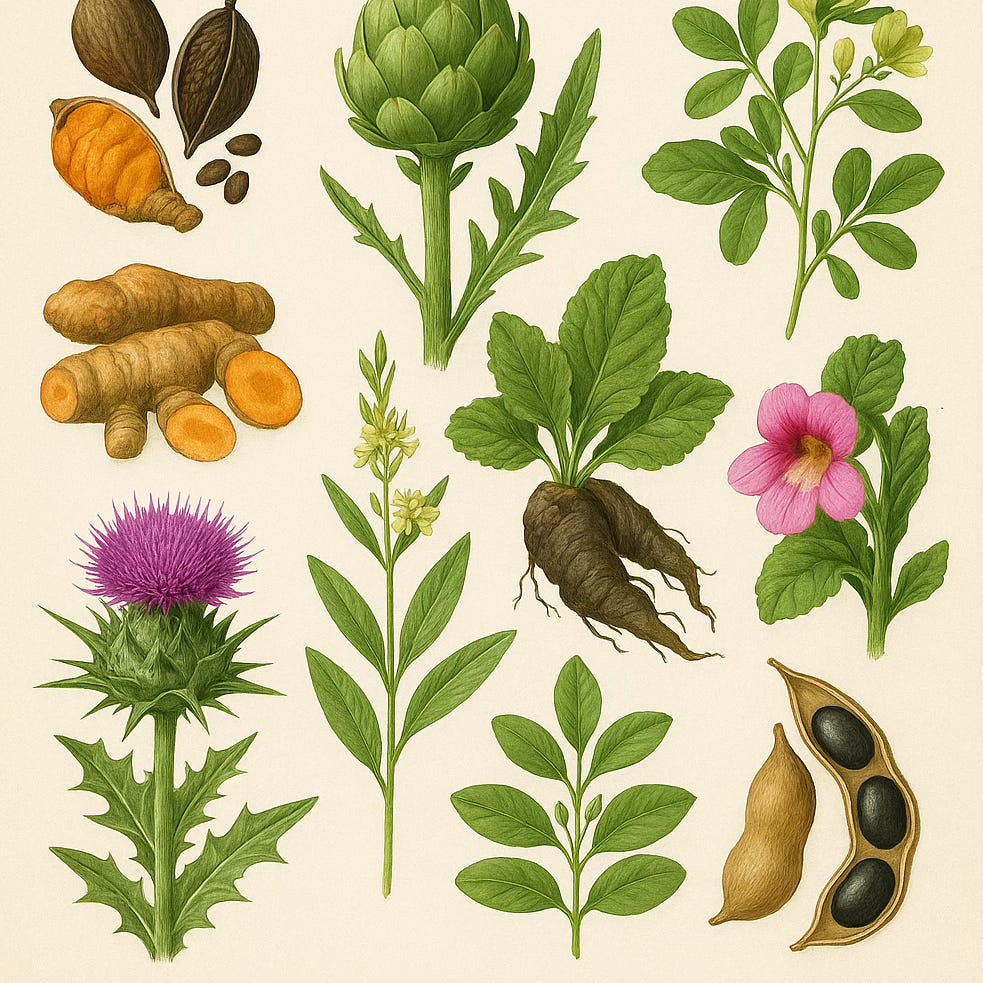
Metabolic Activity (Yang)
Excess Yang
Manifestations: hepatic inflammation, elevated liver enzymes, systemic inflammation (e.g., hs-CRP), fatty liver progressing toward NASH, irritability, headaches, bitter taste, red eyes. Here the metabolic oscillator is overdriven—its tempo accelerated—pushing the system into heat, irritability, and inflammatory excess. Bitter–cooling hepatoprotective herbs that reduce oxidative stress, regulate lipids, and promote bile flow can be employed:
Silybum marianum (Milk thistle seed)
Scutellaria baicalensis (Chinese skullcap)
Cynara scolymus (Artichoke leaf)
Tanacetum parthenium (Feverfew leaf)
Cichorium intybus (Chicory root)
Picrorhiza kurroa (Picrorhiza)
Rheum palmatum (Chinese rhubarb)
Deficient Yang.
Manifestations: cholestasis, postprandial fatigue, impaired clearance of hormones or toxins, mitochondrial insufficiency. Here the metabolic clock has slowed—its hands lagging—leaving energy output sluggish and clearance delayed. Warming aromatics and digestive stimulants are often used:
Curcuma longa (Turmeric)
Foeniculum vulgare, Pimpinella anisum, Carum carvi (Fennel, Anise, Caraway)
Zingiber officinale (Ginger)
Cinnamomum verum (Cinnamon)
Allium sativum (Garlic)
In deeper deficiency states, adaptogens may be indicated: Panax ginseng, Eleutherococcus senticosus, Rhodiola rosea, Schisandra chinensis.
Signaling & Autonomic Terrain (Qi)
Qi Stagnation
Manifestations: rib cage tension, PMS, mood lability, autonomic hyperactivity, bile stasis. This is like the signal oscillator caught in a holding pattern—pulses fail to flow, rhythm is constricted, and pressure builds internally. Cooling nervines and smooth-muscle relaxants are used to calm sympathetic tone:
Matricaria recutita (Chamomile)
Mentha × piperita (Peppermint)
Melissa officinalis (Lemon balm)
Nepeta cataria (Catnip)
Stachys officinalis (Wood betony)
Other nodes may require adjunct nervines such as Passiflora incarnata (Passionflower), Albizia julibrissin(Albizzia), Lavandula angustifolia (Lavender)
Qi Deficiency
Manifestations: poor appetite, low mood, fatigue, reduced stress resilience, sluggish hormone clearance. Here the signal clock ticks faintly, underpowered—unable to send strong pulses to keep networks in tune. Stimulant bitters to enhance parasympathetic tone and hepatobiliary flow include:
Bupleurum chinense (Bupleurum)
Taraxacum officinale (Dandelion root)
Mahonia aquifolium (Oregon grape root)
Chelidonium majus (Greater celandine)
Chionanthus virginicus (Fringe tree bark)
Citrus aurantium (Bitter orange)
Fumaria officinalis (Fumitory)
Circulatory Terrain (Blood)
Blood Stasis
Manifestations: portal hypertension, varices, clotting disturbances, purplish complexion, stabbing hepatic or abdominal pain. This resembles an oscillator jammed with static—circulatory rhythms slow, thicken, and lose fluid coherence. Circulatory stimulants and “blood movers” are commonly used:
Angelica sinensis (Dang gui)
Salvia miltiorrhiza (Dan shen)
Rosmarinus officinalis (Rosemary)
Curcuma longa (Turmeric)
Olea europaea (Olive leaf)
Blood Deficiency
Manifestations: pallor, dizziness, brittle nails, insomnia, amenorrhea, depleted antioxidant activity (low glutathione). The blood clock ticks weakly—its amplitude too low to sustain vital circulation and systemic renewal. Blood tonics and nutrient restoratives include:
Paeonia lactiflora (White peony root)
Urtica dioica (Nettle leaf)
Arctium lappa (Burdock root)
Rumex crispus (Yellow dock root)
Rubus idaeus (Red raspberry leaf)
Lycium barbarum (Goji berry)
Form–Fluid Terrain (Yin)
Yin Excess (Phlegm–Damp)
Manifestations: bile stasis, edema, fatty deposits, jaundice, greasy tongue coat, often linked to peripheral hypothyroidism. Here the fluid oscillator is slowed and bogged—its rhythm congested, accumulating dampness and stagnation. Stimulant bitters plus herbs that improve insulin sensitivity and fat catabolism include:
Bupleurum chinense (Bupleurum)
Momordica charantia (Bitter melon)
Gymnema sylvestre (Gymnema)
Syzygium cumini (Jambul)
Trigonella foenum-graecum (Fenugreek)
Nigella sativa (Black cumin)
Yin Deficiency.
Manifestations: hepatic fibrosis, dry eyes, brittle tendons, insomnia from lack of “Yin anchoring.” In this state, the fluid–form clock falters, its reservoir drained—leaving rhythms brittle, dry, and unable to restore repair cycles. Moistening trophorestoratives, often with phytoestrogenic or yin-nourishing qualities, are:
Rehmannia glutinosa (Rehmannia)
Medicago sativa (Alfalfa)
Humulus lupulus (Hops)
Asparagus racemosus (Shatavari)
Ligustrum lucidum (Glossy privet)
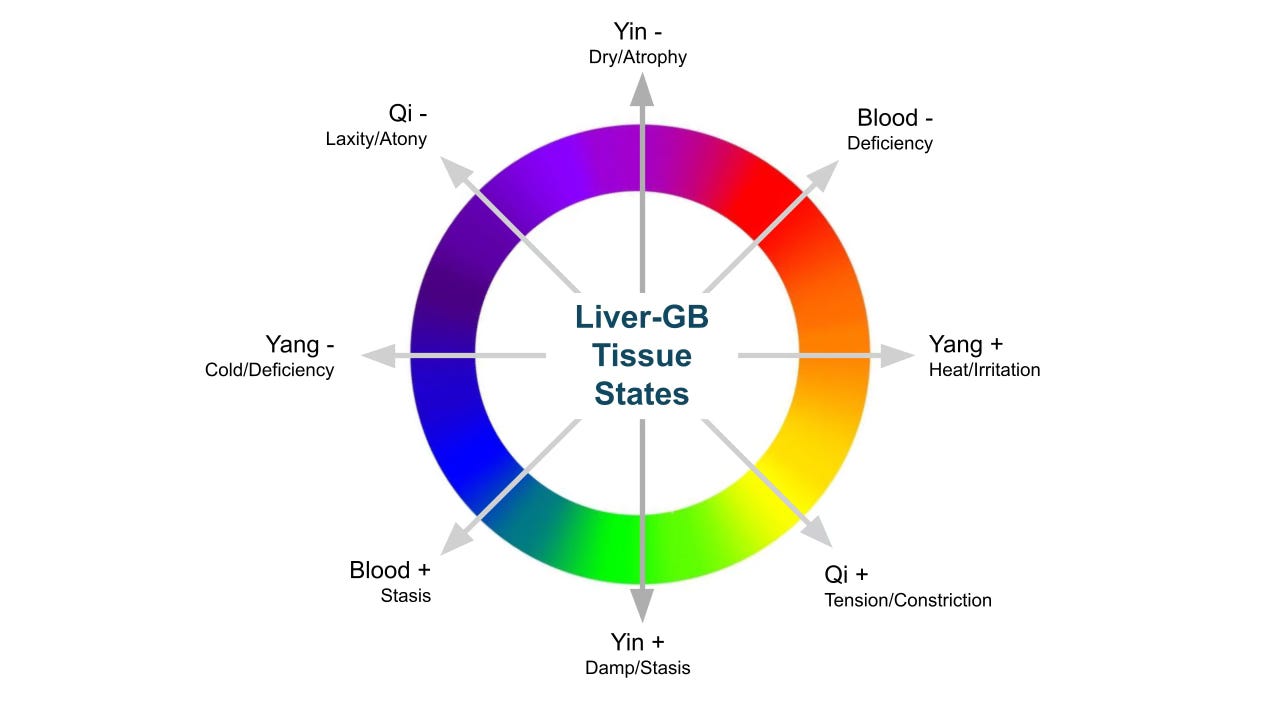
Taken together, these terrain patterns reveal illness not as isolated faults but as clocks out of sync—and herbal strategies, especially in polyherbal form, as means of retuning the oscillators so the hepatobiliary node can once again keep time for the larger physiological network.
Conclusion
The Liver–Gallbladder Node is not merely an anatomical structure but a dynamic, oscillatory hub whose health depends on the interplay of Yang, Qi, Blood, and Yin. Terrain patterns within these dimensions shape how imbalance manifests—whether as inflammation, stagnation, deficiency, or excess. Herbs act not by fixing isolated faults, but by tuning the terrain: dispersing stagnation, nourishing reserves, draining excess, and restoring rhythmic flow. Through this tuning, polyherbal strategies help re-establish the temporal coherence of the hepatobiliary node, supporting systemic resilience.
More broadly, the LG Node exemplifies how organ systems cannot be reduced to static anatomy or singular functions. It is a conductor of rhythms, coordinating metabolism, signaling, circulation, and fluid balance within the larger network of biological clocks. Modern chronobiology affirms what traditional medicine long intuited: health depends not only on what organs do, but on when and how they do it—in synchrony with one another.
From this perspective, illness is less a breakdown of parts than a loss of coherence across time and system. Medicine’s task is not simply to repair organs like broken machines, but to retune the oscillators of the body, restoring harmony, adaptability, and resilience. Herbal therapies, especially polyherbal and terrain-based approaches, embody this principle: by modulating multiple pathways simultaneously, they re-weave coherence into the living web of the body.
As we turn to other primary nodes of the physiological network, the hepatobiliary system stands as a reminder that the rhythms of life are both ancient and contemporary—rooted in tradition, illuminated by science, and always waiting to be brought back into tune.
Note: Some images in this post were generated with the assistance of an AI model.
Prattichizzo F, Frigé C, Pellegrini V, Scisciola L, Santoro A, Monti D, Rippo MR, Ivanchenko M, Olivieri F, Franceschi C. Organ-specific biological clocks: Ageotyping for personalized anti-aging medicine. Ageing Res Rev. 2024 Apr;96:102253. doi: 10.1016/j.arr.2024.102253. Epub 2024 Mar 4. PMID: 38447609.
Buijs RM, Soto Tinoco EC, Hurtado Alvarado G, Escobar C. The circadian system: From clocks to physiology. Handb Clin Neurol. 2021;179:233-247. doi: 10.1016/B978-0-12-819975-6.00013-3. PMID: 34225965.
Martínez-García JJ, Rainteau D, Humbert L, Lamaziere A, Lesnik P, Chamaillard M. Diurnal Interplay between Epithelium Physiology and Gut Microbiota as a Metronome for Orchestrating Immune and Metabolic Homeostasis. Metabolites. 2022 Apr 26;12(5):390. doi: 10.3390/metabo12050390. PMID: 35629894; PMCID: PMC9142987.
Heddes M, Altaha B, Niu Y, Reitmeier S, Kleigrewe K, Haller D, Kiessling S. The intestinal clock drives the microbiome to maintain gastrointestinal homeostasis. Nat Commun. 2022 Oct 14;13(1):6068. doi: 10.1038/s41467-022-33609-x. PMID: 36241650; PMCID: PMC9568547.
Keller M, Mazuch J, Abraham U, Eom GD, Herzog ED, Volk HD, Kramer A, Maier B. A circadian clock in macrophages controls inflammatory immune responses. Proc Natl Acad Sci U S A. 2009 Dec 15;106(50):21407-12. doi: 10.1073/pnas.0906361106. Epub 2009 Dec 1. PMID: 19955445; PMCID: PMC2795539.
Maury E, Navez B, Brichard SM. Circadian clock dysfunction in human omental fat links obesity to metabolic inflammation. Nat Commun. 2021 Apr 22;12(1):2388. doi: 10.1038/s41467-021-22571-9. PMID: 33888702; PMCID: PMC8062496.
Burleson KO, Schwartz GE. Cardiac torsion and electromagnetic fields: the cardiac bioinformation hypothesis. Med Hypotheses. 2005;64(6):1109-16. doi: 10.1016/j.mehy.2004.12.023. PMID: 15823696.
Miao X, Alidadipour A, Saed V, Sayyadi F, Jadidi Y, Davoudi M, Amraee F, Jadidi N, Afrisham R. Hepatokines: unveiling the molecular and cellular mechanisms connecting hepatic tissue to insulin resistance and inflammation. Acta Diabetol. 2024 Nov;61(11):1339-1361. doi: 10.1007/s00592-024-02335-9. Epub 2024 Jul 20. PMID: 39031190.
Lovato CM, Thévenot T, Borot S, Di Martino V, Qualls CR, Urban FK 3rd, Dorin RI. Decreased maximal cortisol secretion rate in patients with cirrhosis: Relation to disease severity. JHEP Rep. 2021 Mar 19;3(3):100277. doi: 10.1016/j.jhepr.2021.100277. PMID: 34027338; PMCID: PMC8121968.
Kasarinaite A, Sinton M, Saunders PTK, Hay DC. The Influence of Sex Hormones in Liver Function and Disease. Cells. 2023 Jun 11;12(12):1604. doi: 10.3390/cells12121604. PMID: 37371074; PMCID: PMC10296738.
Bruinstroop E, van der Spek AH, Boelen A. Role of hepatic deiodinases in thyroid hormone homeostasis and liver metabolism, inflammation, and fibrosis. Eur Thyroid J. 2023 Apr 13;12(3):e220211. doi: 10.1530/ETJ-22-0211. PMID: 36892852; PMCID: PMC10160546.
Uyama N, Geerts A, Reynaert H. Neural connections between the hypothalamus and the liver. Anat Rec A Discov Mol Cell Evol Biol. 2004 Sep;280(1):808-20. doi: 10.1002/ar.a.20086. PMID: 15382020.
Konrad D, Wueest S. The gut-adipose-liver axis in the metabolic syndrome. Physiology (Bethesda). 2014 Sep;29(5):304-13. doi: 10.1152/physiol.00014.2014. PMID: 25180260.
Nakajima H, Nakajima K, Takaishi M, Ohko K, Serada S, Fujimoto M, Naka T, Sano S. The Skin-Liver Axis Modulates the Psoriasiform Phenotype and Involves Leucine-Rich α-2 Glycoprotein. J Immunol. 2021 Apr 1;206(7):1469-1477. doi: 10.4049/jimmunol.2000502. Epub 2021 Mar 1. PMID: 33648938.
Mukherji A, Bailey SM, Staels B, Baumert TF. The circadian clock and liver function in health and disease. J Hepatol. 2019 Jul;71(1):200-211. doi: 10.1016/j.jhep.2019.03.020. Epub 2019 Mar 28. PMID: 30930223; PMCID: PMC7613420.
what's your sense, PK, of how the temporally oscillatory nature of the Liver-Gallbladder node relates to syndromes of limbic/emotional oscillation? It seems both are examples of what TCM would call shaoyang syndrome, with its hot/cold alternation; and that in limbic oscillation this occurs on an emotional level. Perhaps it's just different octaves of the same oscillatory pattern.